

Book Now

Mardi Himal Trek - 5 Days

1174 reviews
461 reviews
Trip Facts
Duration
5 Days
Trip Grade
Moderate
Country
Nepal
Maximum Altitude
4,250 meter
Starts
Pokhara
Ends
Pokhara
Group Size
1-30
Activities
Trekking
Best Time
Spring and Autumn

The Mardi Himal Trek offers a hidden gem in the Annapurna region, known for its striking views, diverse landscapes, and quiet trails away from the crowds. Starting with a scenic drive from Pokhara, this 5-day journey immerses you in the pristine beauty of the Himalayas. From terraced fields to lush rhododendron forests, each day brings new natural wonders, culminating in panoramic mountain vistas at High Camp and the Upper Viewpoint. Here, trekkers are rewarded with breathtaking views of Annapurna South , Machhapuchhre (Fishtail) , Hiunchuli , and even the distant Dhaulagiri range.

The route itself ascends gradually, providing enough time for trekkers to adapt to the altitude. Highlights include an overnight in Forest Camp surrounded by dense forest, the vibrant sunrise at the Upper Viewpoint, and the warm hospitality of traditional Gurung villages like Sidhing. Concluding with a relaxing return to Pokhara , the Mardi Himal Trek combines the beauty of alpine and forest landscapes, a sense of tranquility, and unforgettable cultural experiences in one unforgettable adventure through the Annapurna region.

Highlights of the Mardi Himal Trek - 5 Days

  • Breathtaking Mountain Views : Enjoy stunning, up-close views of Annapurna South , Machhapuchhre (Fishtail) , Hiunchuli , and Dhaulagiri from vantage points like High Camp and the Upper Viewpoint.
  • Less-Crowded Trails : Experience a more peaceful journey through the Himalayas, with quiet trails and fewer trekkers, ideal for those seeking solitude and serenity.
  • Diverse Landscapes : Trek through varied terrains, from terraced farmlands and dense rhododendron forests to high alpine meadows, each offering a unique perspective of the region's natural beauty.
  • Traditional Gurung Culture : Interact with locals in villages like Sidhing and Deurali , getting a taste of traditional Gurung lifestyle and hospitality.
  • Sunrise at Upper Viewpoint : Witness a magical sunrise over the Annapurna range, illuminating the peaks in shades of pink and gold—a truly unforgettable sight.
  • Flora and Fauna : Trek through biodiversity-rich forests, home to unique flora and fauna, including colorful rhododendrons, langur monkeys, and diverse bird species.
  • Ideal for Short-Time Trekkers : With a 5-day itinerary, it’s perfect for trekkers with limited time who still want a rewarding high-altitude trekking experience.
  • End in Pokhara : Relax in Pokhara after your trek, enjoying the lakeside atmosphere, delicious food, and views of the Annapurna range as a perfect conclusion to your adventure.
Customize Trip
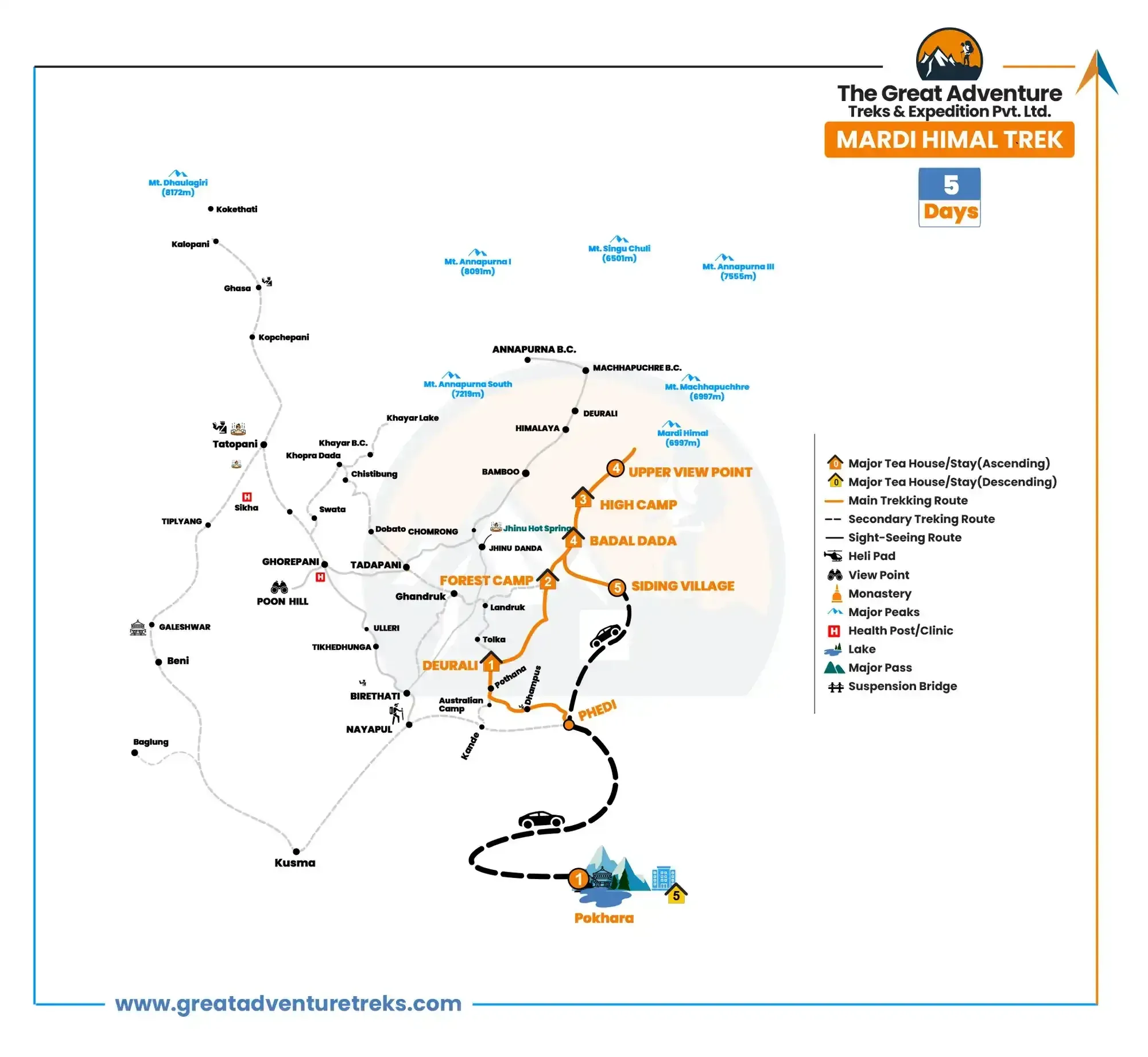
Mardi Himal Trek - 5 Days Outline Itinerary

Mardi Himal Trek - 5 Days Itinerary: Day‑by‑Day Details

Day 1

Drive to Phedi and trek to Deurali (2100 m/ 6888 ft) (9km / 5.5mi) 30 minutes drive, 4-5 hrs trek, Tea House Accommodation.

Our Mardi Himal adventure begins with a scenic 30-40 minute drive from Pokhara to Phedi , the starting point of your trek. From Phedi, the trail ascends through terraced fields and traditional Gurung villages, eventually leading into lush rhododendron forests. The path is well-marked, with plenty of spots to rest and take in views of the Annapurna and Machhapuchhre (Fishtail) mountains. After a steady 4-5 hour trek, you’ll reach Deurali , a peaceful hilltop village that offers sweeping views of the surrounding valleys.

Duration: 5-6 hours
Meals: Lunch, Dinner
Accommodation: Tea house
Day 2

Deurali to Forest Camp (2520 m/ 8266 ft) (6km / 3.7mi) 6-7 hrs, Tea House Accommodation.

Leaving Deurali, the trail takes you deeper into the forest, gradually climbing through a beautiful mix of oak, pine, and rhododendron trees. This stretch is known for its quiet, unspoiled beauty, often undisturbed by other trekkers. As you move further along, keep an eye out for local wildlife, such as langur monkeys and a variety of bird species. After trekking for 6-7 hours, you’ll arrive at Forest Camp , a small settlement with simple tea houses surrounded by dense forest and mountain scenery.

Max Altitude: 2,520m (8,267ft)
Duration: 6-7 hrs
Meals: Breakfast, Lunch, Dinner
Accommodation: Tea House
Day 3

Forest Camp to High Camp (3540 m/11,611 ft) (8km/ 4.97mi) 6-7 hrs, Tea House Accommodation.

Today’s trek to High Camp is both challenging and rewarding, as you ascend higher along the ridge. The trail gradually climbs above the treeline, offering clear views of the Annapurna and Machhapuchhre ranges. After passing Low Camp , the landscape changes dramatically, with expansive views of snow-capped peaks and alpine grasslands. The final ascent to High Camp can be steep, but the panoramic vistas of the Himalayas make every step worthwhile.

Max Altitude: 3,540m (11,614ft)
Duration: 6-7 hrs
Distance: 8km
Meals: Breakfast, Lunch, Dinner
Accommodation: Tea House
Day 4

High Camp to upper viewpoint (4250 m/ 13,940 ft) (3.6km/ 2.23mi) return back to Badal Dada (3210m/10531ft) 7-8 hrs, Tea House Accommodation.

Today, you’ll start early to reach the Upper Viewpoint , the highest point of the trek. The steep ascent from High Camp is challenging but incredibly rewarding, offering stunning panoramic views of Annapurna I , Annapurna South , Machapuchare , and other peaks as the sun rises over the mountains. After spending time at the viewpoint, taking in the magnificent scenery, you’ll descend back to Badal Danda , located at a lower altitude, for a more restful night.

Max Altitude: 4,250m (13,943ft)
Meals: Breakfast, Lunch, Dinner
Day 5

Badal Dada to Sidhing Village (1700 m/5576 ft) (8.3km/5.5mi) Drive to Pokhara 7-8 hrs, Hotel Accommodation.

The final day of your trek takes you down to Sidhing Village through dense forests and small local settlements. Sidhing is a traditional Gurung village, where you’ll experience the rich cultural heritage of the locals. Once you arrive, a vehicle will pick you up for the drive back to Pokhara. Relax in Pokhara after an exhilarating journey in the Annapurna region, enjoying the vibrant lakeside atmosphere and views of the surrounding mountains.

Max Altitude: 1,700m (5,577ft)
Duration: 7-8 hrs
Distance: 8.3km
Meals: Breakfast, Lunch
Accommodation: Hotel

Trip Cost Details

Includes

  • Free Luggage stored at "The Great Adventure Treks" office store during the trek.
  • Pokhra to Phedi by private vehicle
  • Professional trekking Guide with government license.
  • Sherpa Porter who will carry 20 Kg. Max (1 sherpa porter for 2 guests)
  • All meals during the trek: Breakfast, Lunch and dinner.
  • Purified drinking water (Ef-Chlor water purification tablet).
  • Tea house accommodation during the trek (Twin sharing basis).
  • Annapurna Conservation Area Project (ACAP) Permit
  • TIMS(Trekkers Information Management System) card.
  • Necessary Equipment : sleeping bag, Down Jacket, Duffle Bag if needed (Return back to the company after the trek).
  • First-Aid kit from The Great Adventure Treks & Expedition including oximeter.
  • Staff Insurance, Food, salary, Transport and clothing.
  • Trekking completion achievement Certificate after completing the trek.
  • Emergency Rescue Help (covered by your travel insurance).
  • Siddhing Village to Pokhara by sharing jeep
  • All government and local taxes.

Excludes

  • Personal Travel Insurance
  • Food and accommodation in Pokhara.
  • Extra expenses : All drinks(Hard and soft drinks), Wi-Fi, laundry, Hot shower during the trek.
  • personal gears, upgraded accommodations.
  • Tips for staff.
  • Additional Porter cost : USD $23 per day.

Private Trip

Equipment Lists for Mardi Himal Trek - 5 Days

Upper Body Layers
  • Down Jacket
  • Wind Jacket
  • Rain Coat
  • Thermals (Top)
  • Day Shirts
Lower Body Layers
  • Trekking Pant
  • Thermals (Bottom)
  • Knee Support
Footwear & Accessories
  • Trekking Shoes
  • Camp Shoes
  • Socks
  • Crampons
  • Gloves
Head & Sun Protection
  • Trekking Hat
  • Skull Cap
  • Sunglass
  • Sunscreen Cream
  • Neck Gaiter
Personal & Medical Kits
  • First-Aid Kit
  • Water Purifier (Aquatabs)
  • Towel
  • Toiletries
Travel Documents
  • Permits
  • Passport
  • Insurance Details
Miscellaneous
  • Duffel Bag
  • Money Pouch
  • Day Pack
  • Sleeping Bag
  • Trekking Poles
  • Head Light
  • Power Bank
  • Water Bottle

Essential Information

Best Time and Season for Mardi Himal Trek

The Mardi Himal Trek is best undertaken during two primary trekking seasons in Nepal: spring (March to May) and autumn (September to November). These periods offer favorable weather, clear skies, and stunning views of the Annapurna range, including Mardi Himal, Machhapuchhre (Fishtail), and Hiunchuli.

Spring (March to May)

  • Weather: The temperature is moderate, with warm days and cool nights, making it comfortable for trekking.
  • Scenery: This season is known for blooming rhododendron forests that color the trails with vibrant pinks and reds, adding to the trek’s beauty.
  • Visibility: Clear skies in the mornings and evenings offer stunning mountain views.

Autumn (September to November)

  • Weather: This is the most popular trekking season due to its stable and dry weather conditions. The temperatures are pleasant during the day, although nights can be cooler at higher altitudes.
  • Scenery: After the monsoon, the landscape is lush and green, and the air is crisp, offering the clearest mountain vistas.
  • Festive Vibes: Autumn coincides with major Nepali festivals like Dashain and Tihar, giving trekkers a chance to experience local culture.

Other Seasons

  • Winter (December to February): The trek is still possible but comes with colder temperatures, especially at High Camp and the Upper Viewpoint. Snowfall can make trails challenging but offers a unique, serene experience with fewer trekkers.
  • Monsoon (June to August): The trails are wet and slippery due to heavy rain, and visibility is often obscured by clouds. However, the off-season brings fewer crowds and lush greenery. Trekkers need to be prepared for leeches and potential trail disruptions.

Choosing the best time depends on your preferences, but for the most enjoyable experience, spring and autumn are highly recommended.

Difficulties of Mardi Himal Trek

The Mardi Himal Trek is considered a moderate trek, but it comes with its share of challenges that trekkers should prepare for:

  1. Altitude Gain: The trek reaches a maximum altitude of 4,250 meters at the Upper Viewpoint. Although relatively lower than some other treks, altitude sickness can still be a concern for some trekkers. Proper acclimatization and hydration are essential to minimize risks.
  2. Steep Ascents and Descents: The trail includes steep climbs, particularly on the way to High Camp and the Upper Viewpoint. These sections require good stamina and physical fitness, as they can be demanding on the legs.
  3. Remote Trails: The path to Mardi Himal is less developed compared to more popular routes like Annapurna Base Camp. The trails are narrow, rocky, and in some sections, uneven, which can be challenging, especially in wet or snowy conditions.
  4. Weather Conditions: The weather in the Himalayas can be unpredictable. Sudden rain, fog, or snow may affect visibility and trail conditions, making it harder to navigate certain sections.
  5. Basic Accommodation: Tea houses along the route are simple, offering limited amenities. Trekkers need to be prepared for basic facilities, especially in the higher altitudes where comfort can be compromised.
  6. Cold Temperatures: As the trek ascends, temperatures can drop significantly, particularly at night in High Camp. Proper layering and warm gear are necessary to stay comfortable.
  7. Limited Connectivity: Cellular and internet networks are sparse, especially in higher altitudes, making communication and access to assistance challenging in emergencies.
  8. Physical Fitness: While not extremely strenuous, the trek requires trekkers to walk 5-7 hours daily on challenging terrain. A reasonable level of fitness and preparation is essential to enjoy the experience without overexertion.

Proper preparation, gear, and awareness can help mitigate these difficulties, ensuring a rewarding and memorable adventure in the Himalayas.

Mardi Himal Trek - 5 Days FAQs

How difficult is the Mardi Himal Trek?

The Mardi Himal Trek is considered a moderate trek. It involves daily walks of 4–7 hours on steep and rugged trails, requiring basic fitness and stamina. It’s suitable for beginners with some prior trekking experience.

What is the best season for the Mardi Himal Trek?

The best seasons are Spring (March–May) and Autumn (September–November). During these times, the weather is stable, and the skies are clear, offering breathtaking views of the Annapurna range and Mardi Himal.

Do I need a guide for Mardi Himal trek?

While the trail is well-marked, hiring a guide is recommended for safety, local knowledge, and to enhance your trekking experience. Guides also help in navigating less-traveled routes and dealing with altitude-related challenges.

What permits are required for Mardi Himal trek?

You’ll need the Annapurna Conservation Area Permit (ACAP) and the TIMS (Trekkers’ Information Management System) card , which can be arranged in Kathmandu or Pokhara.

How high does the trek go?

The highest point on the Mardi Himal Trek is the Upper Viewpoint at 4,250 meters (13,940 feet).

Is altitude sickness a concern on this trek?

Though the trek involves moderate altitude, some trekkers may experience mild altitude sickness. Staying hydrated, acclimatizing properly, and ascending gradually helps mitigate the risks.

Are there Wi-Fi and charging facilities on the trek?

Wi-Fi and charging are available at most teahouses, but the connection may be slow, and charging often comes with an additional fee, especially at higher altitudes.

Can beginners do the Mardi Himal Trek?

Yes, the trek is beginner-friendly, provided you have a basic level of fitness and are prepared for uphill climbs and long walks.

Is drinking water available on the Mardi Himal trek?

Drinking water is available at teahouses and along the trail. Bring a reusable water bottle and water purification tablets or a filtration system.

Proper planning and preparation will make your Mardi Himal Trek safe, enjoyable, and memorable.

Check General FAQs
Need Help? Call Us+977 9851029614